
What causes a stiff knee?
The most common cause is scar tissue after trauma or surgery. Other causes need to be excluded, because treatment differs.
- Arthrofibrosis: excessive scar tissue after ligament reconstruction, fracture fixation, knee replacement or a long period in a cast or brace.
- Mechanical blocks: a displaced meniscus tear, a loose body or a scarred graft (a 'cyclops' lesion after ACL reconstruction).
- Arthritis: osteoarthritis or inflammatory arthritis with bony spurs and capsule tightening.
- Infection: a less common but important cause, particularly after surgery.
- Muscle and soft-tissue tightness: after prolonged bed rest or quadriceps injury.
Why does knee movement matter?
Even a small loss of movement can affect daily life. Most people need around 90 degrees of bending to climb stairs comfortably and more to squat or sit cross-legged. A knee that cannot fully straighten makes walking tiring and overloads the front of the knee; see bent knee (flexion deformity) for more on this.
How is a stiff knee assessed?
Assessment includes measuring how far the knee bends and straightens, checking the kneecap's mobility, and asking about the timeline of stiffness. X-rays check implants, fracture healing and arthritis. MRI can show scar tissue or a mechanical block. If infection is suspected, blood tests and sometimes joint fluid analysis are needed.
Treatment options
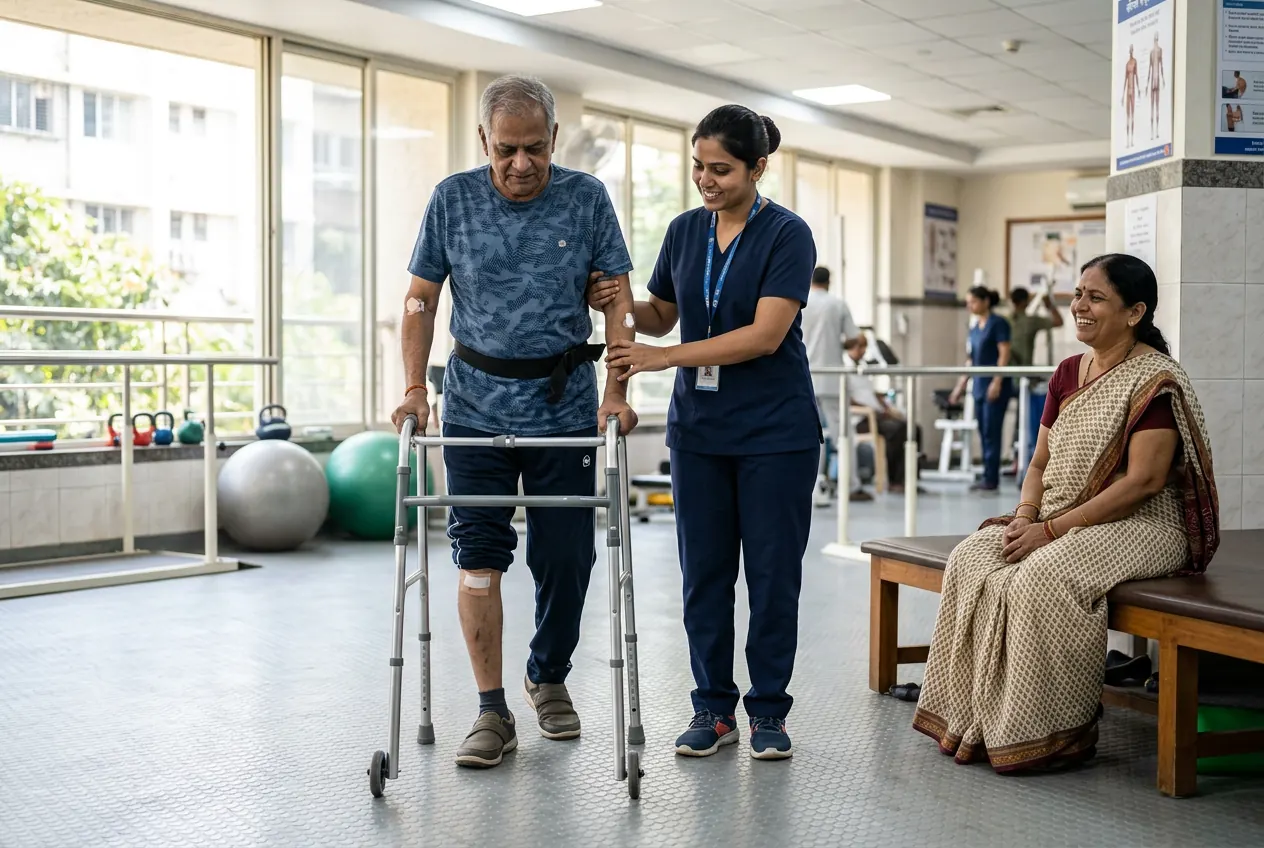
Physiotherapy
Structured, regular physiotherapy is the foundation of treatment. It combines pain control, swelling management, stretching and strengthening, and is most effective when started early. Forcing movement through severe pain can increase inflammation, so the programme is paced.
Manipulation under anaesthesia (MUA)
Under anaesthesia, the knee is gently bent to break up early scar tissue. It is usually considered within the first few months after surgery, when scar tissue is still relatively soft, and is followed straight away by intensive physiotherapy.
Arthroscopic release
When stiffness is established, scar tissue can be removed and tight capsule released through arthroscopic (keyhole) surgery. Mechanical blocks such as a cyclops lesion or loose body are treated at the same time.
Open release
Severe or long-standing stiffness occasionally needs an open procedure, particularly after complex fractures.
Every procedure has risks, including fracture during manipulation, bleeding, infection and recurrence of stiffness. These are explained before treatment.
What can I expect after treatment?
The gain in movement achieved in theatre has to be kept through consistent exercises over the following weeks. Improvement often continues for several months. The final range depends on the cause and how long the knee has been stiff.
Stiffness can follow many knee problems listed on the knee injuries page, including ligament reconstruction.
Home exercises that help a stiff knee
Regular home exercises often make the difference between a partly and a well-recovered knee. Common examples include:
- Heel slides lying on your back, bending the knee as far as comfortable.
- Heel props, resting the heel on a rolled towel to let the knee straighten.
- Seated knee bends on a chair, using the other foot to help.
- Static cycling with the seat set high, lowering it as bending improves.
Short, frequent sessions spread through the day tend to work better than one long painful session. Ice after exercise can control swelling. Your physiotherapist will tailor the programme to your stage of recovery.
Keep a simple record of how far the knee bends and straightens each week. Steady progress is encouraging; if movement stops improving or goes backwards for two to three weeks, contact your treating team, as earlier intervention tends to be more effective.
When to seek urgent care
If a knee becomes hot, red, increasingly swollen and painful, especially with fever or after recent surgery, go to the nearest emergency department, as this may indicate infection.
Who is a Candidate for Stiff Knee Surgery?
You may need surgical treatment if:
- Your knee has limited motion despite 6–8 weeks of physiotherapy
- You experience stiffness after knee surgery or trauma
- You have difficulty bending/squatting/climbing
- Imaging shows scar tissue, joint space narrowing, or implant issues
- You are unable to return to normal activities due to joint stiffness
More about Stiff Knee Treatment
Knee Not Bending or Straightening Properly?
A stiff knee can severely affect your daily life, making it difficult to walk, sit, climb stairs, or perform basic movements. Whether caused by injury, surgery, or arthritis, knee stiffness should not be ignored — especially when conservative treatments fail.
Dr. Karnav Panchal, a leading orthopedic surgeon in Ahmedabad, offers advanced evaluation and surgical treatment for chronic or post-operative stiff knee conditions, helping patients regain motion, reduce pain, and restore joint function.
What is a Stiff Knee?
A stiff knee refers to a condition where the knee joint loses its normal range of motion, making it hard to bend (flexion) or straighten (extension). This can result from inflammation, scar tissue (fibrosis), joint damage, or complications after knee surgery or trauma.
Common Causes of Knee Stiffness
- Post-surgical stiffness (e.g., after knee replacement or ligament surgery)
- Prolonged immobilization (after fractures or injury)
- Arthrofibrosis – excessive scar tissue inside the joint
- Advanced arthritis or joint degeneration
- Infections within the knee joint
- Failed previous knee surgeries
- Neglected ligament or meniscus injuries
Symptoms of a Stiff Knee
- Reduced ability to bend or straighten the knee
- Tightness or “locked” feeling in the joint
- Difficulty walking, squatting, or using stairs
- Swelling, pain, or clicking sounds
- Instability or limping due to joint restriction
- Inability to sit cross-legged or perform deep bends
Diagnosis by Dr. Karnav Panchal
A detailed evaluation includes:
- Physical examination of range of motion
- X-rays or MRI to check joint damage, bone spurs, or fibrosis
- Assessment of past surgeries, injury history, or infection signs
A personalized treatment plan is created based on cause and severity.
1. Non-Surgical Management (Early Cases)
- Physiotherapy & guided exercises
- Manual mobilization to improve flexibility
- Anti-inflammatory medications
- PRP or regenerative injections for inflammation
- Knee bracing or assistive devices
Effective in mild to moderate stiffness
First-line option for early-stage stiffness
Arthroscopic Knee Release (Arthrolysis)
- Keyhole surgery to remove scar tissue and adhesions
- Restores full range of motion
- Minimal invasion and faster recovery
Ideal for post-op stiffness and early arthrofibrosis
Manipulation Under Anesthesia (MUA)
- Performed under anesthesia to forcefully restore motion
- Used after recent knee replacement or ligament surgery if stiffness persists
Quick results but best within 6–12 weeks of surgery
Open Release Surgery
- Open procedure to remove dense fibrosis or hardware
- Recommended in severe cases or failed arthroscopic release
Revision Knee Surgery
- In cases where poor implant positioning or infection causes stiffness
- Previous joint replacement may need to be revised for better motion
Corrects mechanical issues and improves joint function
Benefits of Stiff Knee Treatment
- Improved joint flexibility and range of motion
- Relief from chronic pain and stiffness
- Better ability to walk, sit, and climb stairs
- Prevents permanent joint contracture
- Enhanced quality of life and independence
Who is a Candidate for Stiff Knee Surgery?
You may need surgical treatment if:
- Your knee has limited motion despite 6–8 weeks of physiotherapy
- You experience stiffness after knee surgery or trauma
- You have difficulty bending/squatting/climbing
- Imaging shows scar tissue, joint space narrowing, or implant issues
- You are unable to return to normal activities due to joint stiffness
Dr. Karnav Panchal will guide you through the most effective path to recovery based on your condition and goals.
Advanced Care Facilities in Ahmedabad
Dr. Panchal treats patients in top hospitals equipped with:
- Advanced arthroscopy & surgical suites
- Joint motion assessment tools
- Post-operative physiotherapy & rehab centers
- Complete infection control and safety protocols
Frequently asked questions
Is it too late to treat a knee that has been stiff for a year?
Not necessarily. Long-standing stiffness is harder to treat, but arthroscopic or open release can still improve movement in many cases.
Can a stiff knee after knee replacement be treated?
Yes. Options include physiotherapy, manipulation in the early months and, later, surgical release or revision in selected cases.
How can stiffness be prevented after surgery?
Following the rehabilitation plan, controlling swelling and regaining full straightening early all help reduce the risk.
Can physiotherapy alone cure knee stiffness?
Mild stiffness can improve with guided therapy, but severe or post-surgical stiffness often needs surgical release.
How long is recovery after knee arthrolysis?
Most patients resume light activity in 2–4 weeks. Full range restoration can take 6–12 weeks with therapy.
Will the stiffness come back after treatment?
With proper rehabilitation and adherence to post-op care, recurrence is rare. Regular exercises prevent long-term stiffness.
Can stiffness occur after knee replacement?
Yes, it’s one of the common complications. Early movement, therapy, and — if needed — manipulation or surgical release can correct it.
Is surgery painful?
Modern pain management techniques ensure minimal discomfort during and after the procedure.
This page offers general information. The right treatment depends on your examination, imaging and personal goals. Request a consultation to discuss your situation with Dr. Karnav Panchal.