
Awaiting medical review. This draft article is being reviewed by Dr. Karnav Panchal and is not yet indexed by search engines. It is general information, not medical advice.
How does knee arthroscopy work?
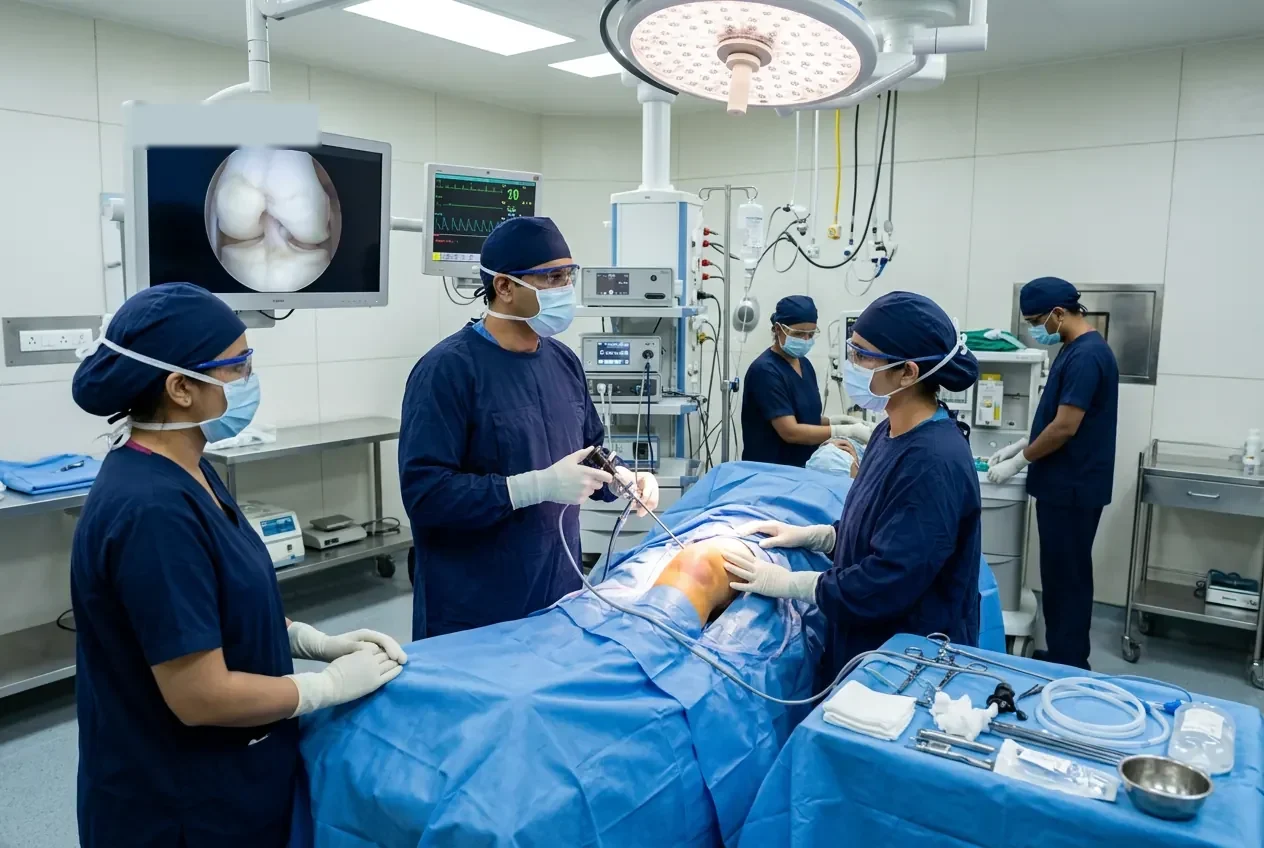
The operation is usually done under spinal or general anaesthesia. The surgeon makes two or more small incisions around the knee. An arthroscope, a thin tube with a camera and light, shows the inside of the joint on a screen. Sterile fluid expands the joint so the surgeon can see clearly. Small instruments are passed through the other incisions to repair or remove damaged tissue.
Which conditions may be treated?
- Meniscus tears: repair or trimming of the torn part.
- Anterior cruciate ligament (ACL) and other ligament reconstruction.
- Loose bodies: fragments of bone or cartilage floating in the joint.
- Some cartilage injuries in selected patients.
- Kneecap (patella) instability procedures.
- Inflamed joint lining (synovitis) in specific conditions.
- Stiffness due to scar tissue, in selected cases.
What are the possible benefits?
Compared with open surgery, arthroscopy uses smaller incisions, which may mean less pain early on, smaller scars and a quicker return to daily activities for many people. It allows the surgeon to see the joint directly and treat certain problems in the same procedure. Benefits depend on the condition being treated and on rehabilitation afterwards.
Arthroscopy can also confirm a diagnosis when examination and scans leave some doubt, although it is rarely used for diagnosis alone today because MRI usually gives the information needed without an operation. Smaller incisions do not mean the inside of the knee heals faster; repaired tissue still needs time, and the rehabilitation plan reflects what was done rather than the size of the cuts.
Is arthroscopy useful for knee osteoarthritis?
Generally, no. Good-quality research has shown that arthroscopic washing out or trimming of the knee for degenerative osteoarthritis alone is unlikely to give more benefit than non-surgical care such as exercise and physiotherapy. Many guidelines advise against it for this purpose. Arthroscopy may still be considered in someone with arthritis if there is a clear mechanical problem, such as a loose body causing true locking. Read about other options in our guide to knee osteoarthritis.
What are the risks?
Knee arthroscopy is commonly performed, but it is still surgery. Possible risks include:
- Infection.
- Blood clots in the leg veins.
- Bleeding into the joint and persistent swelling.
- Stiffness.
- Injury to nerves or blood vessels, which is rare.
- Risks related to anaesthesia.
- Symptoms not improving as hoped.
What are the alternatives?
Depending on the problem, alternatives may include physiotherapy, activity changes, bracing, weight management, pain relief guided by your doctor and injections in selected cases. For advanced arthritis, realignment surgery or knee replacement may be more appropriate than arthroscopy. Your surgeon should explain why arthroscopy is or is not recommended for you, and you are welcome to ask about each alternative in turn.
How is the decision for arthroscopy made?
Arthroscopy is recommended when there is a specific problem inside the knee that it can treat, and when that problem matches your symptoms. A scan finding alone is not enough, because many people have changes on MRI that cause no trouble. Your surgeon will consider:
- Whether you have mechanical symptoms such as true locking or catching.
- Whether there was a clear injury and what structures were damaged.
- How much arthritis is present on standing X-rays.
- Whether you have given non-surgical treatment a fair trial, where appropriate.
- Your activity level and goals.
Asking what the procedure is expected to achieve, and what the plan would be if it does not help, is a reasonable part of the discussion.
How to prepare for knee arthroscopy
Before surgery you will usually have a pre-operative check, which may include blood tests and a review of your medicines. Some medicines, such as blood thinners, may need to be adjusted on medical advice. You will be told when to stop eating and drinking before the anaesthetic.
Learning your post-operative exercises in advance, arranging transport home and planning help for the first few days can make recovery smoother. Practising walking with crutches beforehand may be useful if you will need them. Working on thigh muscle strength before surgery, when advised, may also help you recover afterwards.
What is recovery like?
Many people go home the same day or the next day. Recovery depends on what was done. After a simple procedure such as trimming, daily activities may resume within weeks. After repair or reconstruction, there may be restrictions on bending or weight-bearing and a longer rehabilitation programme. These are typical ranges that vary.
When to seek urgent care: go to the nearest emergency department if you develop fever with increasing knee pain and swelling, wound discharge, a painful swollen calf or breathlessness after surgery.
Discuss your situation with Dr. Karnav Panchal to find out whether arthroscopy is suitable for your knee problem.
Common questions
Is knee arthroscopy a major operation?
It is less invasive than open surgery, but it is still an operation with anaesthesia and risks. Recovery depends on the procedure performed.
Will arthroscopy fix my arthritic knee?
Arthroscopy is generally not recommended for osteoarthritis alone. Exercise, weight management and other treatments are usually tried, with joint replacement considered for advanced cases.
Will I have scars after knee arthroscopy?
Arthroscopy leaves small scars where the instruments were inserted. They usually fade over time, though how they heal varies between people.
How soon can I walk after knee arthroscopy?
Many people walk with or without support soon after simple arthroscopy. After repairs or reconstruction, walking may be protected for a time.
Related treatment page: Arthroscopy. To talk about your own symptoms, request a consultation.