
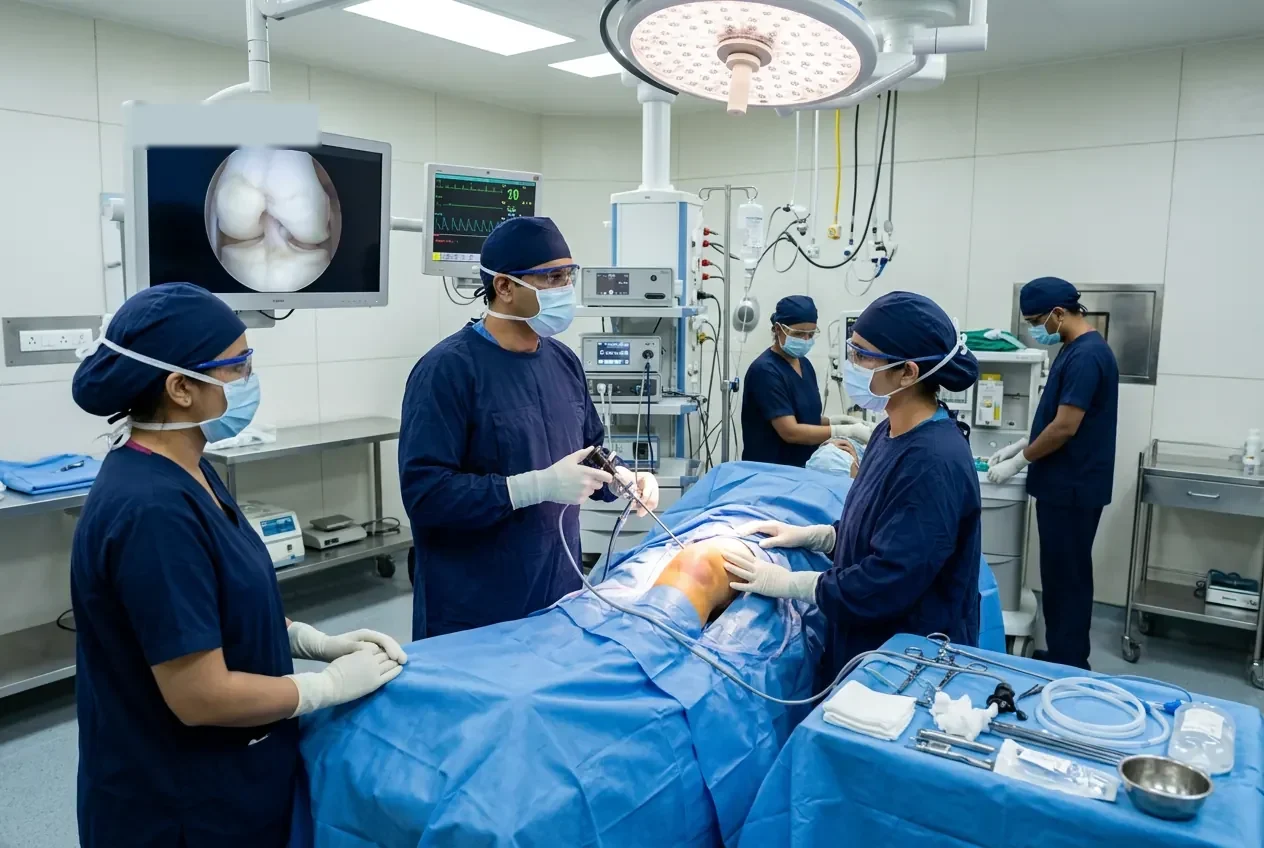
What is arthroscopy?
Arthroscopy is a minimally invasive way to look inside a joint and perform surgery without opening it fully. An arthroscope, a thin camera about the width of a pencil, shows the inside of the joint on a screen, and instruments are inserted through one or more other small cuts. Compared with open surgery, it usually means smaller scars and less disturbance of the surrounding tissue.
Joints and procedures
Knee arthroscopy
Knee arthroscopy is used for ACL and posterior cruciate ligament (PCL) reconstruction, meniscus repair or trimming, cartilage procedures and patellar stabilisation. As a knee arthroscopy surgeon in Ahmedabad, Dr. Panchal performs it for injuries confirmed on examination and imaging. Our article what is knee arthroscopy explains the procedure step by step.
Shoulder arthroscopy
Used for recurrent dislocation (labral repair), rotator cuff repair, SLAP tears, impingement and release of a resistant frozen shoulder. See shoulder injuries.
Ankle arthroscopy
Used for impingement, cartilage lesions of the talus, os trigonum removal and arthroscopy-assisted ankle or subtalar fusion.
Elbow and hip arthroscopy
Elbow arthroscopy may treat loose bodies, stiffness and osteochondritis dissecans. Hip arthroscopy is used in selected cases, for example certain labral or impingement problems.
What arthroscopy can and cannot do
Arthroscopy works well for specific mechanical problems such as a torn ligament, an unstable meniscus tear, a loose body or a dislocating shoulder. It is generally not an effective treatment for widespread arthritis: “washing out” an arthritic knee has not been shown to give lasting benefit in most patients. For advanced arthritis, other treatments, including joint replacement, may be more appropriate. Arthroscopy is also rarely needed only to make a diagnosis, because MRI and examination usually answer that question.
Preparing for arthroscopy
Before surgery, the diagnosis is confirmed by examination and imaging, usually an MRI. Routine blood tests and an anaesthetic check are arranged, and blood-thinning medicines are reviewed. For ligament and cartilage procedures, starting physiotherapy before surgery to reduce swelling and restore movement may help recovery afterwards. You will be told whether to expect a brace, sling or crutches, so that you can plan time off work and help at home.
Risks of arthroscopy
Arthroscopy is generally considered a low-risk procedure, but complications can occur, including infection, bleeding into the joint, blood clots, stiffness, nerve injury, failure of a repair and anaesthetic risks. These are discussed before surgery.
Recovery after arthroscopy
Many patients go home the same day or the next day. Recovery depends mainly on what was done inside the joint: a simple trimming procedure may allow normal walking within days, whereas a ligament reconstruction or rotator cuff repair needs a brace or sling and a rehabilitation programme lasting several months. Physiotherapy is a key part of the result. Your surgeon will give you a timeline for your procedure; these are typical ranges and vary between patients.
Frequently asked questions
Is arthroscopy a major operation?
It uses small incisions, but it is still surgery under anaesthesia. The scale of recovery depends on the repair performed.
Can arthroscopy help knee arthritis?
For most people with knee arthritis, arthroscopy alone is not helpful. It may be considered when there is a specific mechanical problem such as a locked knee.
How long will I be in hospital?
Many arthroscopic procedures need a day-care or overnight stay, but this varies with the procedure and your health.
When can I return to sport?
It depends on the procedure. Simple procedures may allow return in weeks; reconstructions usually take months of rehabilitation.
This page offers general information. The right treatment depends on your examination, imaging and personal goals. Request a consultation to discuss your situation with Dr. Karnav Panchal.