
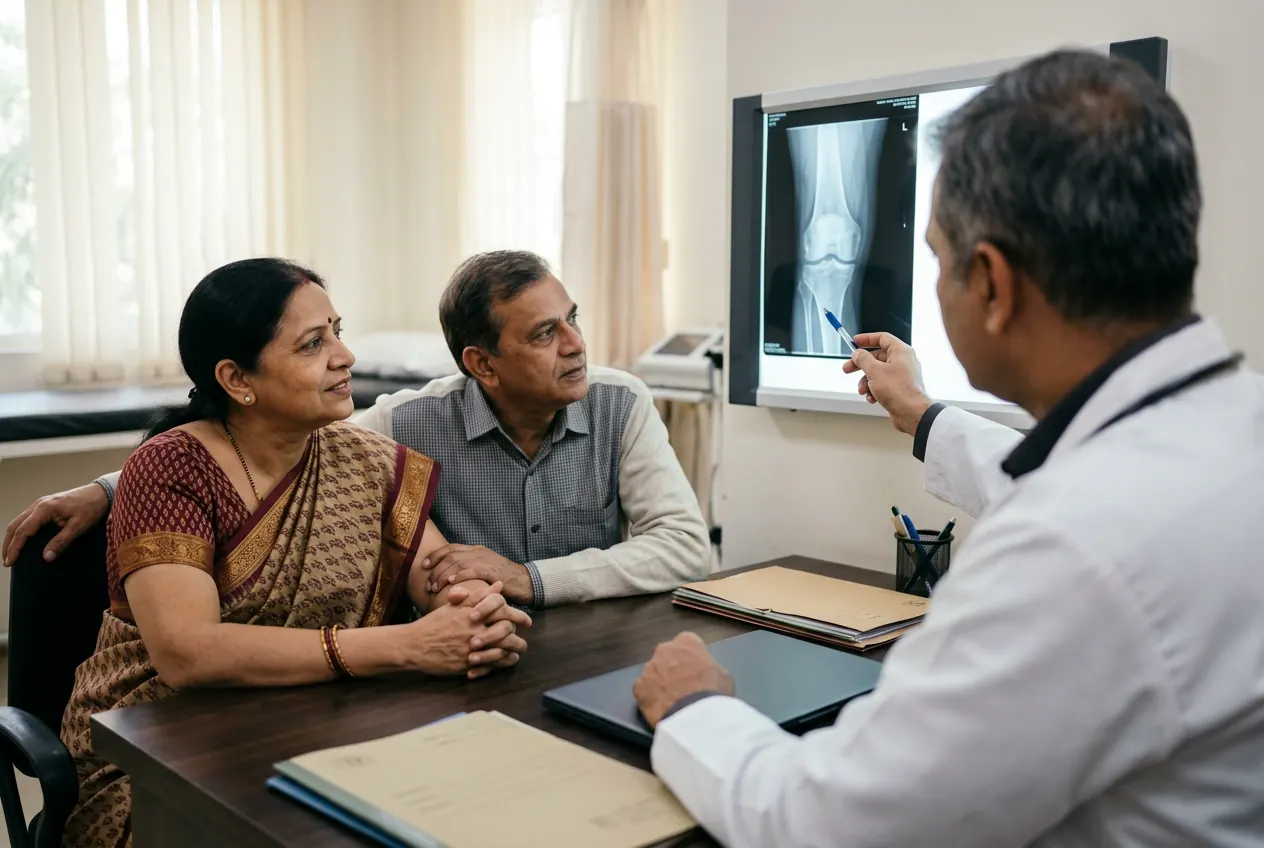
What is a partial knee replacement?
A partial knee replacement replaces only the damaged surface of one of the knee’s three compartments: the medial (inner), lateral (outer) or patellofemoral (behind the kneecap). The most common is a medial unicondylar replacement. Terms such as “microplasty” refer to particular instrument systems used to place the implant accurately through a smaller incision.
Who is suitable?
Partial knee replacement is generally considered when:
- Arthritis is clearly limited to one compartment, with pain mainly on that side
- The anterior cruciate ligament (ACL) and other ligaments are intact and the knee is stable
- The knee bends well and does not have a fixed flexion contracture
- Any bow-leg or knock-knee deformity is mild and correctable
- There is no inflammatory arthritis such as rheumatoid arthritis
Final suitability is sometimes confirmed only during surgery. If the other compartments turn out to be worn, a total knee replacement may be the better choice, and this is discussed beforehand.
Possible advantages
Because less bone and soft tissue are disturbed, many patients find that a partial knee feels more natural and that early recovery is quicker than after total knee replacement. Blood loss and hospital stay are often less. These advantages apply only when the patient is correctly selected, which is why careful assessment matters.
Limitations and risks
Arthritis can progress in the remaining compartments over time, and some patients later need conversion to a total knee replacement. Other risks are similar to those of any knee replacement: infection, blood clots, stiffness, persistent pain, implant loosening or bearing problems, and nerve or vessel injury. Your individual risks are explained before surgery.
Recovery after partial knee replacement
Most patients walk with support on the day of surgery or the next day and go home after a short stay. Physiotherapy focuses on bending, straightening and strengthening the knee. Many people resume routine activities over several weeks, and low-impact exercise such as walking, cycling and swimming is usually encouraged once healing allows. Timelines vary between patients.
How is suitability assessed?
Assessment begins with where the pain is felt and a careful examination of ligament stability, range of movement and alignment. Standing X-rays show which compartments are worn. Stress X-rays, taken while the knee is gently pushed in one direction, can show whether the opposite compartment still has healthy cartilage, and an MRI is occasionally used to check the ligaments. Body weight, activity level and expectations are also discussed, because they influence which implant is likely to serve you better over time.
Preparation and alternatives
Preparation is similar to that for other joint replacements: blood tests and a medical fitness check, control of diabetes and blood pressure, review of blood-thinning medicines and treatment of any infection beforehand. Learning your exercises before surgery and arranging help at home for the first couple of weeks can make early recovery smoother.
Other options to consider
For some younger, active patients with arthritis on the inner side and a bow-legged knee, a high tibial osteotomy that realigns the leg may be an alternative. Non-surgical care, including physiotherapy and weight management, is always discussed first. Read more about knee osteoarthritis.
Who Is a Candidate for Partial Knee Replacement?
You may be eligible if you have:
- Isolated osteoarthritis in one knee compartment (medial/lateral/patellofemoral)
- Stable knee ligaments (especially the ACL)
- Good range of motion
- Minimal knee deformity
- No inflammatory arthritis (e.g., rheumatoid arthritis)
More about Partial (Unicondylar) Knee Replacement
Preserve Your Natural Knee. Get Relief Where It Matters.
Not all knee problems require a full knee replacement. For patients with arthritis or damage limited to one part of the knee, Partial Knee Replacement offers a minimally invasive solution with faster recovery, less pain, and more natural movement.
Dr. Karnav Panchal, a renowned orthopedic and joint replacement surgeon in Ahmedabad, specializes in Microplasty, Unicondylar Knee Replacement, and Partial Knee Replacement — delivering precise, patient-specific treatment to help you return to a pain-free, active life.
What is Partial Knee Replacement?
Partial Knee Replacement (PKR) — also known as Unicondylar Knee Replacement — is a surgical procedure that replaces only the damaged portion of the knee joint (medial, lateral, or patellofemoral compartment), preserving healthy bone and ligaments.
This is ideal for patients whose knee arthritis is limited to a single compartment rather than the whole joint.
Understanding the Terms
- Microplasty: A minimally invasive surgical approach using smaller incisions and specialized instruments, often combined with robotic or computer-guided techniques for precision.
- Unicondylar Knee Replacement: Refers to replacing only one condyle (compartment) of the knee — either medial (inner side) or lateral (outer side).
- Partial Knee Replacement: The broader term covering unicondylar and patellofemoral replacements, preserving more of your natural knee structure.
All three approaches aim to reduce pain and restore mobility without replacing the entire knee.
Who Is a Candidate for Partial Knee Replacement?
You may be eligible if you have:
- Isolated osteoarthritis in one knee compartment (medial/lateral/patellofemoral)
- Stable knee ligaments (especially the ACL)
- Good range of motion
- Minimal knee deformity
- No inflammatory arthritis (e.g., rheumatoid arthritis)
Dr. Karnav Panchal uses advanced diagnostics and imaging to determine if you’re a good candidate for this tissue-preserving procedure.
Benefits of Partial Knee Replacement
Smaller Incision & Less Tissue Damage
Faster Recovery Time
Lower Blood Loss
Retains Healthy Bone and Ligaments
More Natural Knee Function
Shorter Hospital Stay
Ideal for Younger, Active Patients or Early-Stage Arthritis
Dr. Karnav Panchal’s Expertise in Partial Knee Surgeries
Dr. Karnav Panchal combines surgical skill with advanced technology to ensure highly accurate, patient-specific outcomes. He performs:
- Microplasty with navigation or robotic assistance
- Medial or Lateral Unicondylar Knee Replacement
- Patellofemoral (Kneecap) Replacement
- Custom implant matching for anatomy and mobility
With hundreds of successful surgeries, Dr. Panchal is regarded as a leading expert in partial knee replacement in Ahmedabad.
State-of-the-Art Facilities & Technology
Dr. Karnav Panchal operates in Ahmedabad’s top orthopedic hospitals equipped with:
- Robotic-assisted surgery systems (where available)
- Computer-navigated instruments
- Infection-controlled surgical suites
- Dedicated rehab and physiotherapy units
- Minimal access surgical tools for microplasty
Who is a Patient for Knee Replacement?
Dr. Karnav Panchal’s Expertise in Partial Knee Surgeries
- Dr. Karnav Panchal combines surgical skill with advanced technology to ensure highly accurate, patient-specific outcomes. He performs:
Microplasty with navigation or robotic assistance
- Medial or Lateral Unicondylar Knee Replacement
- Patellofemoral (Kneecap) Replacement
- Custom implant matching for anatomy and mobility
With hundreds of successful surgeries, Dr. Panchal is regarded as a leading expert in partial knee replacement in Ahmedabad.
Serving Patients Across Ahmedabad & Gujarat
Dr. Karnav Panchal has helped patients across Ahmedabad, Gandhinagar, Rajkot, Vadodara, Surat, and beyond. Patients seeking faster recovery and less invasive options choose partial knee replacement as a preferred solution.
Frequently asked questions
Is partial knee replacement better than total knee replacement?
Modern implants can last 10–15 years or more with proper care and moderate activity levels.
How do I know if I am suitable?
Suitability is decided after examination and X-rays, sometimes with additional stress X-rays or an MRI, and occasionally confirmed during surgery.
Can a partial knee be converted to a total knee later?
Yes. If arthritis progresses or the implant has problems, conversion to a total knee replacement is possible.
What is the recovery time for unicondylar or microplasty knee replacement?
Most patients begin walking the same day or next day, and resume normal activities within 3–6 weeks.
Is microplasty surgery painful?
Microplasty is minimally invasive, meaning less post-op pain, smaller incisions, and a smoother recovery compared to traditional surgery.
How long does a partial knee replacement last?
Modern implants can last 10–15 years or more with proper care and moderate activity levels.
This page offers general information. The right treatment depends on your examination, imaging and personal goals. Request a consultation to discuss your situation with Dr. Karnav Panchal.