
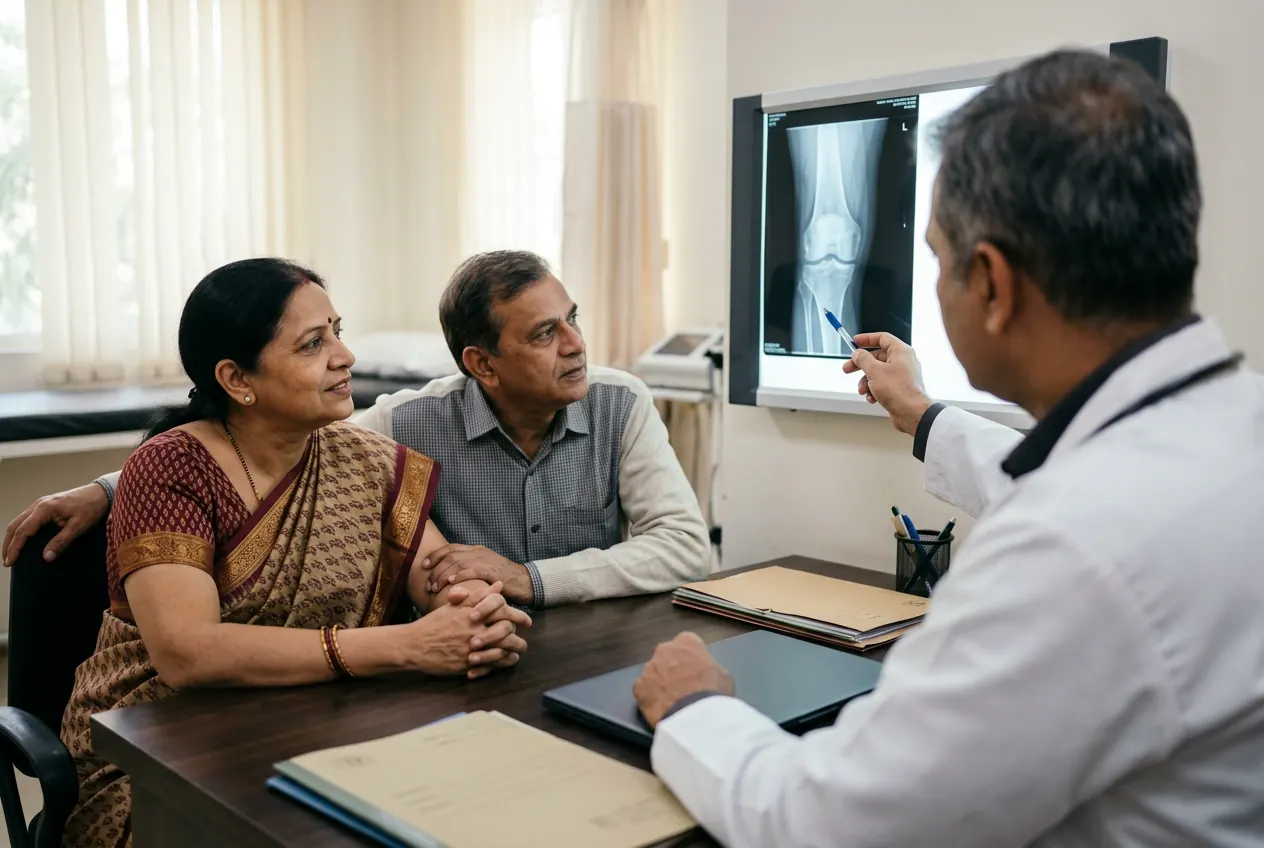
What is a cartilage defect?
A cartilage defect is a localised area where the joint surface (articular cartilage) is damaged or missing. A chondral defect affects only the cartilage; an osteochondral defect also involves the bone underneath. Cartilage has no blood supply, so it has a very limited ability to repair itself.
A focal defect is different from osteoarthritis, where cartilage wears down more widely across the joint. The distinction shapes treatment, because cartilage repair techniques are designed for focal defects in otherwise healthy knees.
What causes cartilage damage?
- Twisting injuries and direct blows, often together with ligament or meniscus tears.
- Kneecap dislocation, which can shear cartilage off the kneecap or groove.
- Osteochondritis dissecans, where a fragment of bone and cartilage loosens, usually in adolescents and young adults.
- Long-standing instability or malalignment that overloads one part of the knee.
Symptoms and assessment
Cartilage defects typically cause aching pain during or after activity, swelling, and sometimes catching or locking if a loose fragment is present. MRI shows the size and depth of most defects, and X-rays check alignment and wider arthritis. The exact grade is often confirmed during arthroscopy.
Non-surgical treatment
Small defects that cause few symptoms are often managed with physiotherapy, weight management, activity changes and pain relief. Injection treatments may be discussed where appropriate. These measures aim to reduce symptoms; they do not regrow cartilage.
Surgical options for cartilage repair
Surgery is considered when a defect causes persistent symptoms. The choice depends on the defect size and location, your age and activity, and the health of the rest of the knee.
- Debridement and loose body removal: smoothing unstable edges and removing fragments that cause catching.
- Fixation: re-attaching a large, healthy fragment, mainly in osteochondritis dissecans.
- Microfracture (marrow stimulation): small holes in the exposed bone let marrow cells form repair tissue. It is generally used for smaller defects; the repair tissue is fibrocartilage rather than normal cartilage.
- Osteochondral grafting: plugs of cartilage and bone are moved from a less loaded part of the knee, or donor tissue is used, to fill the defect.
- Cell-based cartilage repair: techniques such as autologous chondrocyte implantation, where the patient's own cartilage cells are grown and re-implanted, are used for selected larger defects.
Any instability or malalignment is corrected as well, sometimes with a high tibial osteotomy, because a repair placed in an overloaded knee is less likely to last. Risks include stiffness, infection, incomplete healing and the need for further surgery.
A clinical and research interest
Cartilage repair and regeneration is one of Dr. Karnav Panchal's stated areas of interest. He worked as a co-investigator in a Phase III clinical trial assessing autologous cultured chondrocytes for articular cartilage defects of the knee.
Protecting the cartilage you have
Whatever the treatment, protecting healthy cartilage helps the knee over the long term. Keeping body weight in a healthy range reduces the load through the knee with every step. Strong thigh and hip muscles absorb impact and improve control. Low-impact activities such as cycling, swimming and walking are generally kinder to damaged cartilage than repeated jumping and pivoting. Treating instability, such as a torn ligament or a dislocating kneecap, helps prevent further damage. If swelling after activity keeps returning, a review is sensible, since a loose fragment or progressing defect may need attention.
Recovery
Rehabilitation after cartilage surgery is slow because the repair tissue needs time to mature. Protected weight bearing for several weeks is common, and return to impact sport may take many months, typically longer after cell-based repair. Timelines vary between patients and procedures.
Procedures offered
- Microfracture Technique: Creates tiny holes in bone to stimulate new cartilage-like tissue growth.
- OATS (Osteochondral Autograft Transfer System): Healthy cartilage from non-weight bearing area is transferred to damaged area.
- Autologous Chondrocyte Implantation (ACI): Cartilage cells are harvested, cultured, and re-implanted to repair defect.
- Matrix-induced ACI (MACI): An advanced form of ACI using a bio-matrix to hold cartilage cells in place.
- Cartilage Restoration with Stem Cells: Emerging treatment using stem cells to regenerate cartilage tissue.
Who is a Patient for Cartilage Disorder Treatment?
- You may be a candidate for cartilage repair or restoration if you: Are under 50 years of age and want to delay knee replacement Have isolated cartilage damage from injury or sports Experience knee pain, swelling, or stiffness that limits movement Want to preserve your natural joint for long-term activity Are not responding to conservative treatments Are an athlete or active individual seeking joint preservation Dr. Karnav Panchal offers advanced treatment to protect your joint, avoid early arthritis, and restore knee function.
- Are under 50 years of age and want to delay knee replacement
- Have isolated cartilage damage from injury or sports
- Experience knee pain, swelling, or stiffness that limits movement
- Want to preserve your natural joint for long-term activity
- Are not responding to conservative treatments
- Are an athlete or active individual seeking joint preservation
More about Knee Cartilage Injury Treatment in Ahmedabad
What Are Cartilage Disorders?
Cartilage is the smooth, rubbery tissue that cushions your joints and enables painless movement. In the knee, cartilage lines the ends of bones and helps absorb shock. When damaged due to injury, wear-and-tear, or degeneration, it leads to pain, swelling, and restricted mobility — often worsening over time if untreated.
Dr. Karnav Panchal, an experienced orthopedic surgeon in Ahmedabad, offers advanced diagnostic and surgical solutions for cartilage injuries and degeneration, helping patients return to active, pain-free living.
Common Types of Knee Cartilage Disorders
- Articular Cartilage Injury – damage to the smooth cartilage lining the joint
- Chondral Defect – localized wear or loss of cartilage due to trauma
- Osteochondritis Dissecans (OCD) – bone/cartilage fragment separates from joint surface
- Cartilage Thinning/Osteoarthritis – progressive loss of cartilage with age
- Meniscus-related Cartilage Wear – secondary cartilage damage from meniscal injuries
Symptoms of Cartilage Damage
- Persistent or intermittent knee pain
- Swelling after activity
- Catching or locking sensation in the joint
- Clicking or grinding sounds
- Stiffness, especially after sitting or rest
- Reduced knee flexibility or range of motion
Diagnosis by Dr. Karnav Panchal
- Dr. Panchal uses a combination of:
Clinical knee examination
- MRI imaging to detect cartilage lesions
- Diagnostic arthroscopy in complex cases
This precise evaluation helps determine the type, size, and location of the cartilage damage, guiding a personalized treatment approach.
Non-Surgical Management
- Anti-inflammatory medications
- Viscosupplement (gel) injections
- Platelet-Rich Plasma (PRP) therapy
- Physiotherapy for muscle strengthening
Surgical Options
- Depending on the severity and patient profile, Dr. Karnav Panchal offers:
Arthroscopic Debridement
- Removal of loose cartilage fragments for smoother joint function.
Why Choose Dr. Karnav Panchal for Cartilage Repair?
Fellowship-trained in joint preservation and sports injuries
Advanced arthroscopic cartilage repair procedures
Patient-specific treatment with focus on long-term joint health
Minimally invasive surgery and faster recovery
State-of-the-art facilities and modern rehabilitation programs
Treated at the Best Orthopedic Hospitals in Ahmedabad
- Dr. Panchal consults and operates at premier hospitals equipped with:
High-resolution MRI & arthroscopy units
- Clean-room surgical environments
- Modern cartilage cell labs (for ACI/MACI)
- Dedicated physiotherapy & rehab centers
Where You’ll Be Treated
Dr. Karnav Panchal operates at top orthopedic hospitals in Ahmedabad, equipped with:
- Advanced arthroscopy systems
- Sterile surgical environments
- Dedicated sports rehab facilities
- Patient-centered care teams
Serving Patients Across Ahmedabad and Gujarat
Patients from Ahmedabad, Gandhinagar, Vadodara, Rajkot, and Udaipur choose Dr. Karnav Panchal for expert cartilage repair and knee joint preservation solutions.
Frequently asked questions
Can knee cartilage grow back?
Damaged cartilage does not regrow normally on its own. Repair procedures aim to fill the defect with repair tissue or transplanted cartilage.
Is cartilage repair suitable for knee osteoarthritis?
Generally not. Repair techniques are designed for focal defects; widespread arthritis is managed differently.
How long before I can run after cartilage surgery?
Recovery ranges from 6 weeks to 6 months based on the procedure. Rehabilitation plays a key role in full joint restoration.
Can damaged cartilage heal on its own?
Cartilage has limited self-healing ability due to lack of blood supply. Small injuries may improve, but most require medical or surgical treatment.
What’s the best treatment for cartilage damage?
It depends on your age, damage severity, and activity level. Options range from PRP therapy to ACI/MACI and microfracture surgery.
Will I be able to play sports again?
Yes, most patients return to sports or active lifestyle post-treatment, depending on severity and commitment to rehab.
Can cartilage damage lead to arthritis?
Yes, untreated cartilage injury can progress to osteoarthritis, causing chronic pain and joint stiffness.
How long is recovery after cartilage surgery?
Recovery ranges from 6 weeks to 6 months based on the procedure. Rehabilitation plays a key role in full joint restoration.
This page offers general information. The right treatment depends on your examination, imaging and personal goals. Request a consultation to discuss your situation with Dr. Karnav Panchal.