
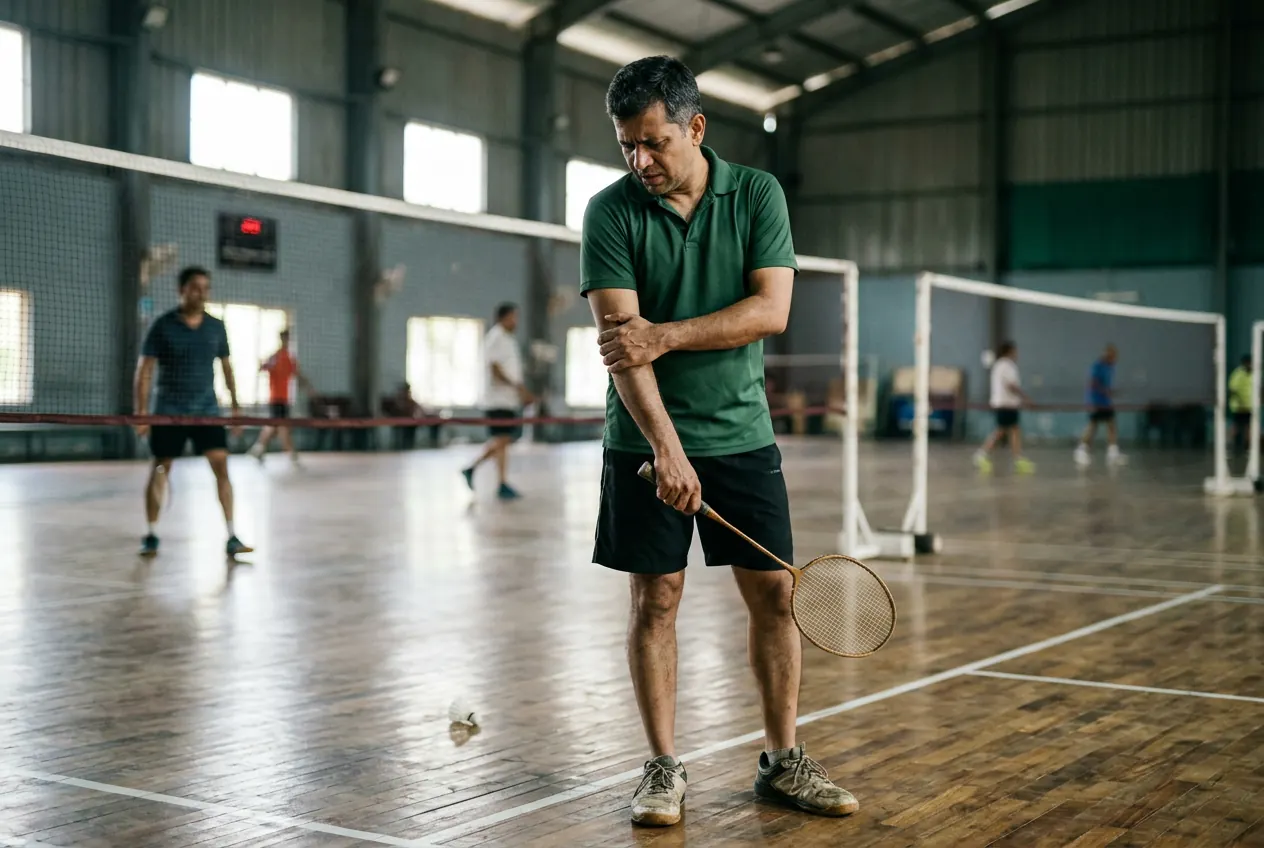
What is tennis elbow?
Tennis elbow is a degenerative change in the common extensor tendon, mainly the extensor carpi radialis brevis, where it attaches to the lateral epicondyle (the bony bump on the outer elbow). Repeated gripping and wrist extension overload the tendon faster than it can adapt. Under a microscope the tendon shows disorganised healing rather than classic inflammation, which is why it is also called lateral elbow tendinopathy.
It most often affects people aged 30 to 50 and is common in manual workers, homemakers, people who use a mouse or tools for long periods, gym-goers and racquet players.
What are the symptoms?
- Pain on the outer elbow that may spread down the forearm.
- Pain when gripping, lifting a kettle or bag with the palm down, turning a key or shaking hands.
- Weak grip and morning stiffness.
Symptoms usually start gradually. Examination finds tenderness just in front of the lateral epicondyle and pain when the wrist or middle finger is extended against resistance. X-rays, ultrasound or MRI are not needed for most people, but may help if the diagnosis is unclear or symptoms persist. Neck problems, nerve entrapment and joint conditions are considered when the pattern is unusual.
How is tennis elbow treated without surgery?
Most people improve with non-surgical treatment, although recovery is often slow, typically over several months and sometimes up to a year or more. Effective care usually combines:
- Activity modification: reducing or changing the provoking tasks, lifting with the palm up, using thicker tool handles and adjusting workstation set-up or racquet grip.
- Physiotherapy: a progressive loading programme, often including eccentric or isometric wrist-extensor exercises, forearm stretching and shoulder and grip strengthening.
- A counterforce brace: a strap worn just below the elbow that may reduce pain during activity.
- Simple pain relief as advised by your doctor, and ice after aggravating activity.
Are injections helpful?
Injections may be considered where appropriate, but they are not a first-line cure. Steroid injections can reduce pain in the short term, but research shows symptoms often return and long-term results may be worse than with exercise alone, so they are used sparingly. Other options such as platelet-rich plasma (PRP) have mixed evidence, and suitability is discussed individually. Injections work best alongside a rehabilitation programme rather than instead of it.
When is surgery considered?
Surgery is considered for a small proportion of people whose symptoms remain significant after six to twelve months of well-structured non-surgical treatment. The aim is to remove the degenerate tendon tissue and stimulate healing at the attachment. This can be done through a small open incision or by elbow arthroscopy, which also allows the joint to be inspected.
Risks include infection, stiffness, nerve irritation, weakness of grip, persistent pain and, rarely, elbow instability. Recovery involves a short period of rest followed by physiotherapy, with return to heavy work or sport over around three to six months; these are typical ranges that vary between patients. Suitability is decided after examination and, where needed, imaging.
Can tennis elbow be prevented from returning?
Keeping forearm and shoulder muscles strong, building up new activities gradually, taking breaks during repetitive work and checking sports technique and equipment may help reduce recurrence. Pain on the inner side of the elbow is a different condition, described on our golfer's elbow page.
Typical recovery timeline
- Conservative treatment: 4–8 weeks
- Post-surgery: Immobilization for 1–2 weeks Gradual return to activities by 4–6 weeks Full recovery and strength restoration in 2–3 months
- Immobilization for 1–2 weeks
- Gradual return to activities by 4–6 weeks
- Full recovery and strength restoration in 2–3 months
Timelines vary with the injury, the procedure and how closely rehabilitation is followed. Your own plan is set at consultation.
Who Is a Candidate for Surgery?
You may require surgical intervention if you:
- Have had symptoms for more than 6 months
- Have no improvement with medication, therapy, or injections
- Experience weakness or limitations in arm function
- Have degenerative tendon changes visible on imaging
- Need to return to sports or heavy manual work
More about Tennis Elbow Treatment in Ahmedabad
Suffering from Elbow Pain That Worsens with Grip or Lifting?
You may have Tennis Elbow, a common overuse injury that affects the outer part of the elbow. Despite its name, this condition affects not only tennis players but also manual workers, homemakers, gym-goers, and office professionals.
Dr. Karnav Panchal, an experienced orthopedic and sports injury specialist in Ahmedabad, offers non-surgical and surgical solutions for Tennis Elbow to help you regain pain-free movement and functionality.
What Is Tennis Elbow?
Tennis Elbow, medically known as Lateral Epicondylitis, is a condition where the tendons that attach to the outer bony prominence of the elbow (lateral epicondyle) become inflamed or degenerated due to repetitive use or strain.
It commonly affects individuals who:
- Use repetitive wrist or arm movements
- Play racquet sports
- Lift heavy objects regularly
- Perform repetitive typing, painting, or carpentry
Causes & Risk Factors
- Repetitive strain from activities involving wrist extension and gripping
- Overuse of forearm muscles
- Improper technique in racquet sports or gym workouts
- Poor ergonomics at work
- Age group: typically between 30 to 50 years
Symptoms of Tennis Elbow
- Pain or burning sensation on the outer part of the elbow
- Weak grip strength
- Discomfort during lifting, shaking hands, or holding objects
- Pain radiating to the forearm or wrist
- Increased pain with repetitive motion or strain
Diagnosis by Dr. Karnav Panchal
- Thorough physical examination to assess tenderness and range of motion
- Specialized tests like Cozen’s test or Mill’s test
- Ultrasound or MRI to assess tendon degeneration or tears
- X-ray to rule out arthritis or bone spurs
1. Conservative (Non-Surgical) Management
Most patients recover with proper conservative care:
- Rest and activity modification
- Anti-inflammatory medications (NSAIDs)
- Tennis elbow bracing or forearm straps
- Physiotherapy with eccentric strengthening exercises
- Ultrasound or shockwave therapy
- PRP (Platelet-Rich Plasma) injections for chronic cases
- Ergonomic correction and posture training
80–90% of patients respond to non-surgical treatment.
2. Surgical Treatment
Recommended when pain persists beyond 6–9 months of conservative therapy.
Minimally Invasive Tennis Elbow Surgery
- Removal of damaged tendon tissue
- Reattachment of healthy tendon
- Can be performed arthroscopically or via a small incision
Fast recovery
High success rates (over 90%)
Return to full activity in 6–8 weeks post-op
Goals & Benefits of Treatment
- Relief from chronic elbow pain
- Restored grip strength and arm function
- Return to daily and work-related activities
- Prevent progression to tendon rupture
- Quick and lasting recovery
Why Choose Dr. Karnav Panchal?
Fellowship-trained in sports injuries and arthroscopic surgeries
Expert in minimally invasive elbow surgery
Personalized care with emphasis on rehabilitation and prevention
Trusted by patients from across Ahmedabad and Gujarat
State-of-the-art surgical and diagnostic facilities
State-of-the-Art Facilities & Technology
Dr. Karnav Panchal operates in Ahmedabad’s top orthopedic hospitals equipped with:
- Robotic-assisted surgery systems (where available)
- Computer-navigated instruments
- Infection-controlled surgical suites
- Dedicated rehab and physiotherapy units
- Minimal access surgical tools for microplasty
Recovery Timeline
- Conservative treatment: 4–8 weeks
- Post-surgery:
Immobilization for 1–2 weeks
- Gradual return to activities by 4–6 weeks
- Full recovery and strength restoration in 2–3 months
Serving Patients Across Gujarat
Patients from Ahmedabad, Gandhinagar, Mehsana, Vadodara, Rajkot, and surrounding regions trust Dr. Karnav Panchal for expert care in elbow injuries and sports-related conditions.
Frequently asked questions
Will tennis elbow go away on its own?
Many cases improve gradually over months, especially with activity changes and exercise. A structured programme usually speeds up progress compared with waiting alone.
Should I rest my arm completely?
Complete rest is not usually recommended. Reducing painful activities while continuing guided exercise helps the tendon adapt.
Is a steroid injection a good idea?
It may give short-term relief, but symptoms often return and repeated injections are generally avoided. It is discussed individually.
How do I know if I need surgery?
Surgery is considered only if significant pain persists after six to twelve months of good non-surgical treatment.
Is Tennis Elbow only seen in tennis players?
No. It can affect anyone who performs repetitive arm and wrist activities.
Are injections effective for Tennis Elbow?
Yes. PRP or corticosteroid injections can help reduce pain and promote healing.
Will I regain full function after treatment?
Yes. Most patients return to full function with proper treatment and rehabilitation.
What if I delay surgery?
Delaying surgery in severe cases may worsen tendon degeneration and prolong recovery.
This page offers general information. The right treatment depends on your examination, imaging and personal goals. Request a consultation to discuss your situation with Dr. Karnav Panchal.