
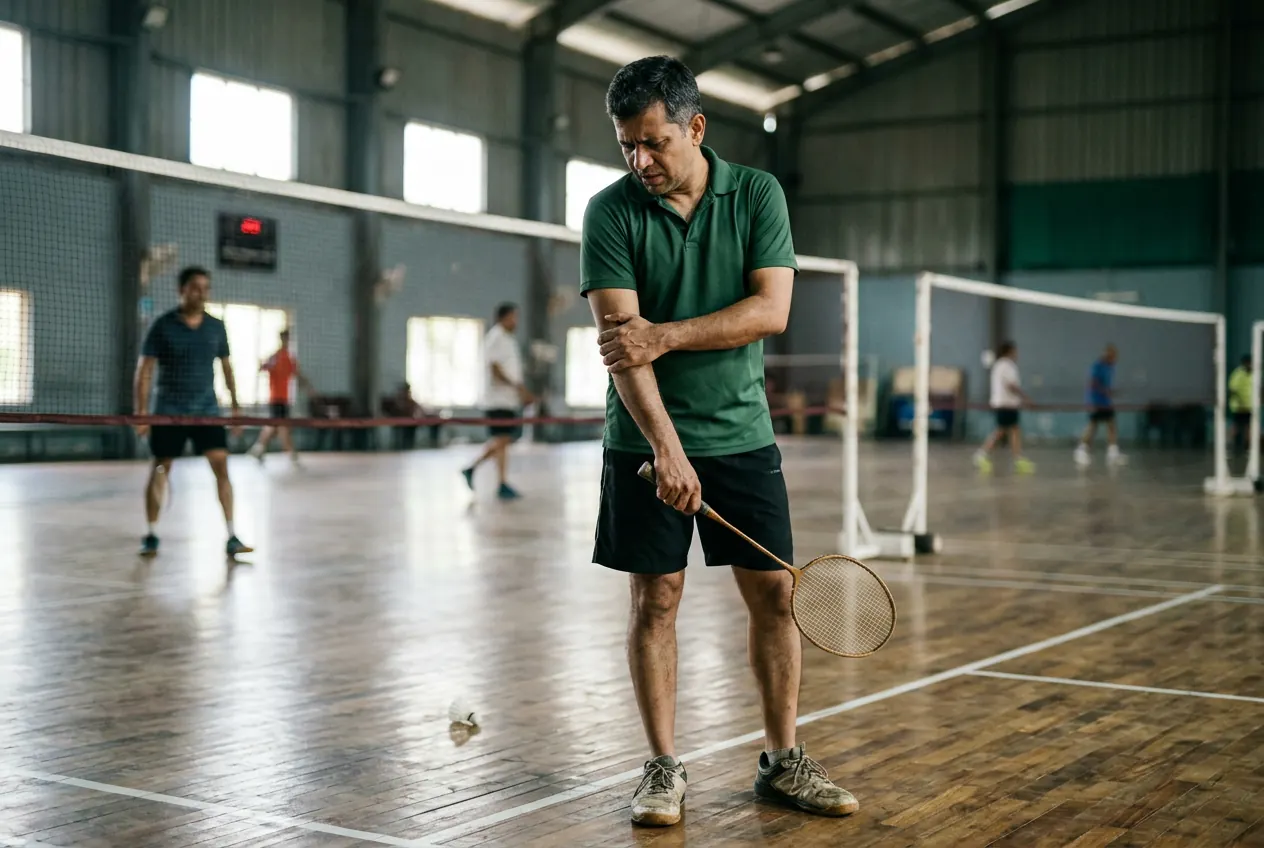
What is golfer's elbow?
Golfer's elbow is a tendinopathy of the common flexor-pronator tendon where it attaches to the medial epicondyle, the bony bump on the inner side of the elbow. The tendon becomes overloaded by repeated gripping, wrist flexion and forearm rotation. It is less common than tennis elbow but behaves in a similar way, with slow, degenerative changes rather than simple inflammation.
Despite its name, it affects many people who never play golf: cricketers and throwers, badminton and squash players, weightlifters, carpenters, plumbers and people doing repetitive manual work.
Symptoms and diagnosis
- Pain and tenderness on the inner elbow, sometimes spreading along the forearm.
- Pain with gripping, carrying, bending the wrist or turning the palm down against resistance.
- Weak grip.
Diagnosis is mainly clinical. X-rays, ultrasound or MRI may be used if symptoms are atypical or persistent, or to check for other causes such as injury to the ulnar collateral ligament in throwing athletes, or joint problems.
Why do ulnar nerve symptoms matter?
The ulnar nerve, often called the funny bone nerve, runs in a groove just behind the medial epicondyle, close to the inflamed tendon. In a proportion of people with golfer's elbow the nerve is also irritated (cubital tunnel syndrome). Warning signs include:
- tingling or numbness in the ring and little fingers;
- symptoms worse with the elbow bent for long periods, such as when using a phone or sleeping;
- clumsiness or weakness of the small hand muscles.
If these are present, the nerve is examined carefully and nerve conduction studies may be advised. Nerve involvement can change treatment, and it is particularly important if surgery is considered.
Non-surgical treatment
Most people improve without surgery, usually over several months. Treatment may include:
- modifying or reducing aggravating tasks and correcting sports technique;
- physiotherapy with progressive strengthening of the wrist flexors and forearm, plus shoulder and core work for throwing athletes;
- a counterforce strap worn below the elbow;
- avoiding prolonged elbow bending at night if the ulnar nerve is irritated;
- an injection in selected cases, used cautiously because of the nearby nerve and limited long-term benefit.
When is surgery considered?
Surgery is considered when significant pain persists after six to twelve months of structured non-surgical treatment. The degenerate tendon tissue is removed and the healthy tendon is repaired to bone through an open incision. If the ulnar nerve is affected, it may be released or moved at the same operation. Unlike some tennis elbow procedures, this is usually not an arthroscopic operation because of how close the nerve lies.
Risks include infection, ulnar nerve or skin nerve injury, stiffness, weakness and persistent pain. Return to heavy work or sport typically takes around three to six months, and varies between patients. Suitability is decided after examination and, where needed, imaging.
How is it different from tennis elbow?
The two conditions are mirror images: golfer's elbow affects the inner side and the muscles that bend the wrist, while tennis elbow affects the outer side and the muscles that straighten it. Some people have both. The exercise programmes differ, so an accurate diagnosis helps.
Typical recovery timeline
- Conservative care: 4–6 weeks of therapy
- Post-surgery: Light activities in 1–2 weeks Gradual strengthening from 4–6 weeks Full return to work/sport: 2–3 months depending on activity level
- Light activities in 1–2 weeks
- Gradual strengthening from 4–6 weeks
- Full return to work/sport: 2–3 months depending on activity level
Timelines vary with the injury, the procedure and how closely rehabilitation is followed. Your own plan is set at consultation.
Who Needs Surgery?
You may be a candidate for surgical intervention if:
- You have had persistent symptoms for 6+ months
- No improvement with rest, therapy, or injections
- Imaging shows tendon degeneration or tearing
- You need full strength for work or sports
- Your pain is affecting daily life or performance
More information
Elbow Pain on the Inner Side While Gripping or Lifting?
You may be suffering from Golfer’s Elbow, also known as Medial Epicondylitis — a condition that causes pain and inflammation where the tendons of your forearm muscles attach to the bony bump on the inside of your elbow.
While it’s common in golfers, it can affect anyone involved in repetitive gripping, lifting, or wrist flexion activities, including athletes, gym-goers, office workers, and manual laborers.
Dr. Karnav Panchal, a leading orthopedic and sports injury specialist in Ahmedabad, provides comprehensive, personalized treatment for Golfer’s Elbow using both non-surgical and minimally invasive surgical techniques.
What Is Golfer’s Elbow?
Golfer’s Elbow is a painful condition caused by overuse or strain of the forearm muscles, especially the wrist flexors that help bend your hand toward your wrist. The repetitive stress leads to microtears and inflammation at the medial epicondyle (inside of the elbow).
Despite the name, it’s not limited to golfers — it’s common in:
- Racquet sport players
- Construction workers
- Weightlifters
- Office workers with poor ergonomics
- People doing repetitive hand/wrist tasks
Causes & Risk Factors
- Repetitive wrist flexion or forearm rotation
- Lifting heavy objects improperly
- Playing sports like golf, baseball, or badminton
- Poor conditioning or technique
- Occupations involving frequent gripping or vibration tools
- Age group: 35–55 years
Symptoms of Golfer’s Elbow
- Pain and tenderness on the inner (medial) side of the elbow
- Pain that radiates to the forearm or wrist
- Weak grip strength
- Stiffness or tightness when bending the wrist
- Discomfort during lifting, gripping, or twisting motions
- Tingling or numbness in fingers (in some cases)
Diagnosis by Dr. Karnav Panchal
- Clinical evaluation and history-taking
- Physical tests like resisted wrist flexion and pronation tests
- X-rays to rule out arthritis or bone spurs
- MRI or ultrasound to assess soft tissue damage
- Diagnostic injections (in chronic cases) to confirm the pain source
1. Non-Surgical Management
Most patients recover well with conservative care:
- Rest and activity modification
- Anti-inflammatory medications (NSAIDs)
- Wrist and elbow bracing
- Physical therapy to strengthen forearm muscles
- Stretching and eccentric exercises
- Shockwave therapy or ultrasound therapy
- PRP (Platelet-Rich Plasma) injections for chronic cases
80–90% of cases improve without surgery.
2. Surgical Treatment
For chronic, resistant pain lasting over 6 months, surgery may be required.
Minimally Invasive Golfer’s Elbow Surgery
- Removal of damaged tendon tissue
- Repair or reattachment of healthy tendon
- Performed via a small incision or arthroscopically
Shorter recovery time
Minimal scarring
High success rate with proper rehab
Benefits of Timely Treatment
- Pain relief and improved elbow function
- Restored grip strength and wrist control
- Return to sports or physical activity
- Prevention of tendon rupture or chronic degeneration
- Minimal downtime with faster rehab
State-of-the-Art Facilities & Technology
Dr. Karnav Panchal operates in Ahmedabad’s top orthopedic hospitals equipped with:
- Robotic-assisted surgery systems (where available)
- Computer-navigated instruments
- Infection-controlled surgical suites
- Dedicated rehab and physiotherapy units
- Minimal access surgical tools for microplasty
Why Choose Dr. Karnav Panchal?
Expert in treating complex elbow and sports injuries
Skilled in arthroscopic and open elbow surgeries
Individualized care plans based on severity and lifestyle
Advanced physiotherapy support for recovery
Trusted by patients across Ahmedabad and Gujarat
Recovery Timeline
- Conservative care: 4–6 weeks of therapy
- Post-surgery:
Light activities in 1–2 weeks
- Gradual strengthening from 4–6 weeks
- Full return to work/sport: 2–3 months depending on activity level
Serving Patients Across Gujarat
Patients from Ahmedabad, Vadodara, Surat, Rajkot, Gandhinagar, and beyond trust Dr. Karnav Panchal for expert care in elbow conditions and sports injuries.
Frequently asked questions
How long does golfer's elbow take to heal?
Most people improve gradually over several months with activity changes and exercise. Recovery time varies, and some cases take longer.
Why do my little and ring fingers tingle?
Tingling in these fingers suggests irritation of the ulnar nerve, which runs close to the inner elbow. It should be mentioned at your consultation.
Is a scan needed for golfer's elbow?
Usually not. The diagnosis is made by examination. Ultrasound, MRI or nerve tests are used when symptoms are unusual, persist despite treatment, or suggest ligament or ulnar nerve involvement.
Can I keep playing sport?
Often yes, with reduced load and corrected technique. Your physiotherapist can guide a graded return.
Is Golfer’s Elbow the same as Tennis Elbow?
No. Tennis Elbow affects the outer elbow (lateral), while Golfer’s Elbow affects the inner side (medial epicondyle).
Will I regain full strength after surgery?
Yes, with proper rehab, most patients regain full strength and flexibility.
Is PRP therapy effective?
Yes, PRP injections can stimulate tendon healing in chronic cases.
Can Golfer’s Elbow heal without surgery?
Yes, most cases improve with rest, physiotherapy, and lifestyle changes.
How is Golfer’s Elbow diagnosed?
Diagnosis is clinical, supported by imaging like ultrasound or MRI when needed.
This page offers general information. The right treatment depends on your examination, imaging and personal goals. Request a consultation to discuss your situation with Dr. Karnav Panchal.