
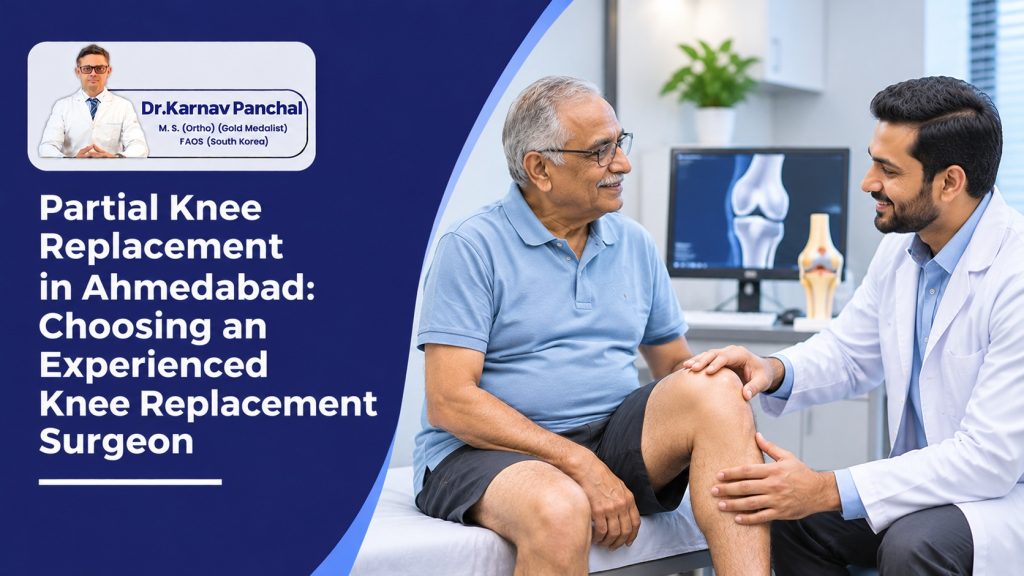
Not every painful, arthritic knee needs a total knee replacement. When the damage is limited to one part of the joint, replacing only that worn area can relieve pain while keeping the healthy bone, cartilage and ligaments you already have. If you are exploring partial knee replacement in Ahmedabad, it is worth learning how microplasty unicondylar partial knee replacement works, who is a good candidate, and why the experience of your surgeon matters so much with this particular operation.
This article explains the procedure in plain terms, compares it with total knee replacement, walks through recovery, and sets out the questions to ask before you choose partial knee replacement in Ahmedabad.
What Is Partial Knee Replacement?
Partial knee replacement in Ahmedabad, as elsewhere, is an operation in which only the damaged compartment of the knee is resurfaced with metal and plastic components, while the rest of the joint is preserved. According to the American Academy of Orthopaedic Surgeons (AAOS), it is an option for advanced osteoarthritis that is limited to a single compartment, and because it uses a smaller incision, patients usually spend little or no time in hospital and return to normal activities sooner than after total knee replacement.
The three compartments of the knee
The knee has three compartments:
- Medial compartment: The inner side of the knee, and the area most commonly affected by osteoarthritis.
- Lateral compartment: The outer side of the knee.
- Patellofemoral compartment: The area behind the kneecap, where it glides over the thigh bone.
When arthritis is confined to one of these three areas and the ligaments are healthy, partial knee replacement in Ahmedabad can be a more conservative alternative to replacing the entire joint.
Other names you may hear
Patients often come across several terms for the same family of procedures, which can be confusing:
- Unicompartmental or unicondylar knee replacement: The formal medical names. You may see unicondylar knee replacement Ahmedabad clinics describe it this way, and unicondylar knee replacement Ahmedabad patients undergo is exactly the same operation discussed in this guide.
- UKR: Short for unicompartmental knee replacement, so UKR surgery Ahmedabad refers to the same operation. If a report recommends UKR surgery Ahmedabad surgeons perform, it means a partial knee.
- Half or mini knee replacement: Informal names. A half knee replacement Ahmedabad patients ask about, or a mini knee replacement Ahmedabad clinics advertise, is a partial knee replacement.
- Oxford knee: A well-known mobile-bearing partial knee implant developed in Oxford, UK. Oxford knee replacement Ahmedabad refers to this specific implant design.
- Microplasty: An instrumentation system designed to improve the precision of Oxford partial knee implantation. Microplasty knee replacement Ahmedabad describes the procedure performed with these instruments.
Whether it is called a half knee replacement Ahmedabad patients ask about or a mini knee replacement Ahmedabad hospitals list, the principle is the same: resurface only the worn compartment and leave the healthy parts of the knee alone. The Wikipedia overview of unicompartmental knee arthroplasty is a useful starting point if you want more background on the terminology.
Who Is a Good Candidate for Partial Knee Replacement in Ahmedabad?
Partial knee replacement in Ahmedabad is best suited to people whose arthritis is confined to one compartment, whose knee ligaments, particularly the ACL, are intact, and whose pain has not improved with medication, physiotherapy, weight management and injections. Careful selection is the single most important factor in a good result after partial knee replacement in Ahmedabad.
Your surgeon will usually check for:
- Arthritis limited to one compartment on standing X-rays and, where needed, stress X-rays or MRI.
- A functioning anterior cruciate ligament (ACL), which keeps the knee stable after a medial partial replacement.
- A correctable deformity, meaning the bow-legged or knock-kneed alignment can be straightened back to neutral.
- Reasonable range of motion, without a severe fixed bend in the knee.
- Pain localised to the affected side, rather than generalised pain across the whole knee.
Early criteria for unicompartmental replacement, published by Kozinn and Scott in 1989, were strict about age, weight and activity levels. Many surgeons, including any experienced uni knee replacement surgeon Ahmedabad patients consult today, now apply them more flexibly, focusing on the pattern of joint damage and ligament health rather than ruling patients out on age alone. That shift is one reason partial knee replacement in Ahmedabad is increasingly discussed with younger, active patients as well as older adults.
A half knee replacement Ahmedabad patients hear about is usually not suitable for inflammatory arthritis such as rheumatoid arthritis, for arthritis affecting more than one compartment, or for knees with a torn ACL or significant instability. In those cases, a primary total knee replacement or, in selected younger patients, a joint-preserving procedure such as high tibial osteotomy may be more appropriate.
Partial vs Total Knee Replacement: What Is the Difference?
When comparing partial knee replacement in Ahmedabad with a total knee, the key difference is how much of the knee is replaced. Total knee replacement resurfaces all three compartments, while partial knee replacement resurfaces only one. That difference has several practical consequences:
- Bone and ligament preservation: Partial replacement keeps the cruciate ligaments and healthy cartilage, which many patients say helps the knee feel more natural.
- Incision and recovery: The smaller approach used in mini knee replacement Ahmedabad patients undergo generally means less blood loss, a shorter hospital stay and a quicker return to daily activities.
- Range of motion: Because more of the natural joint is retained, bending is often closer to normal.
- Long-term considerations: Arthritis can progress in the untreated compartments, and a partial knee may later need conversion to a total knee replacement.
The AAOS notes that modern unicompartmental implants have shown excellent medium- and long-term survivorship when they are used in appropriate patients. The words “appropriate patients” matter. A partial knee placed in the wrong knee is more likely to fail. For a fuller comparison, read our guide to partial vs total knee replacement before your consultation about partial knee replacement in Ahmedabad.
How Is Partial Knee Replacement Performed?
Partial knee replacement in Ahmedabad is precise but not a long operation. A typical sequence looks like this:
- Anaesthesia: Spinal anaesthesia, often with a nerve block for pain control.
- Small incision: A short incision is made over the affected side of the knee, avoiding the large approach used in total knee replacement.
- Confirming the diagnosis: The surgeon inspects all compartments and the ACL to confirm that a partial replacement is appropriate.
- Preparing the bone: Only the damaged surfaces of the femur and tibia are removed, using precise instrumentation. In microplasty knee replacement Ahmedabad surgeons perform, dedicated microplasty guides help set implant position and sizing.
- Balancing and trialling: Trial components are inserted to check ligament balance and movement through the full range.
- Implantation: The final metal components and plastic bearing are fixed, and the wound is closed.
Many patients stand and walk with support on the day of surgery or the next morning. The exact plan for your partial knee replacement in Ahmedabad will depend on your general health and the hospital’s recovery protocol.
Recovery After Partial Knee Replacement in Ahmedabad
Recovery is generally faster than after total knee replacement, although it still requires commitment. Patients choosing partial knee replacement in Ahmedabad should plan for support at home during the first two weeks. A typical recovery pattern after partial knee replacement in Ahmedabad includes:
- First few days: Walking with a frame or crutches, starting knee-bending exercises and managing swelling with ice and elevation.
- Weeks 2 to 6: Progressing to a stick or no support, improving bending and building quadriceps strength. Stitches or clips are usually removed around two weeks.
- Weeks 6 to 12: Returning to most daily activities, including driving once you have good control of the leg and your surgeon agrees.
- After 3 months: Continued improvement in strength and comfort, with low-impact activities such as walking, cycling and swimming.
High-impact sports such as running and jumping are generally discouraged, as they increase wear on any knee implant. Our article on knee replacement recovery covers rehabilitation in more detail.
Risks and Limitations to Discuss
Every operation carries some risk, and partial knee replacement in Ahmedabad is no exception. Alongside general risks such as infection, blood clots and stiffness, partial knee replacement has some specific considerations:
- Progression of arthritis in the remaining compartments, which may need conversion to a total knee.
- Bearing dislocation in mobile-bearing designs, so anyone considering Oxford knee replacement Ahmedabad options should ask about it. It is uncommon but possible.
- Loosening or wear of the components over time.
- Persistent pain if the original pain was not coming from the replaced compartment.
Most of these risks are reduced by careful patient selection and accurate surgical technique during partial knee replacement in Ahmedabad, which brings us to the most important decision of all.
How Do You Choose an Experienced Knee Replacement Surgeon?
Choosing the right surgeon is the most important decision you will make about partial knee replacement in Ahmedabad. The operation is technically demanding, and outcomes are closely linked to how often a surgeon performs it and how carefully patients are selected. When you meet a uni knee replacement surgeon Ahmedabad patients recommend, consider:
- Arthroplasty training: Fellowship training in joint replacement indicates focused experience with knee implants.
- Regular partial knee practice: Ask how often the surgeon performs unicompartmental replacements, not just total knees. A uni knee replacement surgeon Ahmedabad patients can trust will answer this openly.
- Honest candidacy assessment: A good surgeon will tell you if a partial knee is not right for you.
- Implant and technique choice: Ask which implant is used, whether it is fixed or mobile bearing, and why.
- Revision capability: If the knee ever needs conversion to a total replacement, it helps to be under a surgeon experienced in revision surgery.
- Rehabilitation support: Clear physiotherapy guidance makes a real difference in the first three months.
Dr. Karnav Panchal is an orthopaedic surgeon with a special interest in primary, complex and revision joint replacement. He holds an M.S. in Orthopaedics from B. J. Medical College, where he was a gold medallist, completed a fellowship in arthroplasty at Bombay Hospital and a fellowship at St. Mary’s Hospital in South Korea. He consults at Empire Hospital in Sola and at Epic Multispecialty Hospital in Bodakdev, where he is Director of the Freedom Joint Care Centre. For patients looking for a partial knee replacement surgeon Gujarat-wide, including those travelling from North Gujarat, that background in both primary and revision arthroplasty is worth considering. Patients searching for a partial knee replacement surgeon Gujarat-based families recommend should also check follow-up arrangements if they live outside the city.
Partial Knee Replacement in Ahmedabad in 2026: What to Expect
In 2026, partial knee replacement in Ahmedabad is no longer seen as an experimental or niche option. Modern implants and instrumentation, including the systems used for Oxford knee replacement Ahmedabad patients receive and microplasty knee replacement Ahmedabad centres offer, have made the procedure more reproducible, and day-of-surgery mobilisation is now common. Even so, partial knee replacement in Ahmedabad remains a specialist operation, and the principles of good care have not changed:
- Thorough assessment, including weight-bearing and stress X-rays, before any UKR surgery Ahmedabad patients are offered
- Clear criteria for who is and is not a candidate
- Accurate implant positioning and ligament balancing
- Early mobilisation and structured physiotherapy
- Long-term follow-up to monitor the implant and the rest of the knee
Common Mistakes Patients Make
People considering partial knee replacement in Ahmedabad sometimes make decisions that limit their result:
- Choosing a partial knee because it sounds smaller, without confirming they are a suitable candidate for partial knee replacement in Ahmedabad.
- Waiting until the arthritis spreads. Delaying for years can mean the damage reaches other compartments, ruling out a partial replacement.
- Comparing quotes without comparing implants. Different implants and techniques are not interchangeable, and a unicondylar knee replacement Ahmedabad quote should state which implant is used.
- Skipping physiotherapy once walking becomes comfortable.
- Expecting a return to high-impact sport. A partial knee works best for an active but low-impact lifestyle.
Frequently Asked Questions
How long does a partial knee replacement in Ahmedabad last?
The AAOS reports excellent medium- and long-term survivorship for modern partial knee implants in well-selected patients. Longevity depends on correct candidacy, accurate surgery, body weight and activity levels over the years.
Is partial knee replacement better than total knee replacement?
Neither is better for everyone. A partial knee suits arthritis in one compartment with healthy ligaments, while a total knee suits more widespread damage. A careful assessment decides which option fits your knee.
How soon can I walk after partial knee replacement in Ahmedabad?
Many patients walk with support on the day of surgery or the next day. Most move to a stick within a few weeks, though progress depends on general health, pain control and how well physiotherapy is followed at home.
What is the difference between Oxford and microplasty knee replacement?
The Oxford knee is a mobile-bearing partial knee implant. Microplasty refers to precision instruments used to implant it. In practice, microplasty knee replacement usually means an Oxford partial knee placed using these guides.
Can a partial knee replacement be converted to a total knee later?
Yes. If arthritis progresses or the implant wears, a partial knee can usually be converted to a total knee replacement. Choosing a surgeon experienced in revision joint replacement helps if this is ever needed.
Am I too young for partial knee replacement in Ahmedabad?
Age alone is rarely the deciding factor today. Younger, active patients with arthritis in one compartment and a healthy ACL may be suitable. Dr. Karnav Panchal can assess your X-rays and advise whether a partial knee fits your situation.
Do I need an MRI before partial knee replacement in Ahmedabad?
Standing X-rays are usually the main test. An MRI or stress X-rays may be added to check the ligaments and other compartments, especially when the X-rays are borderline or the pain pattern is unclear.
Take the Next Step
Partial knee replacement in Ahmedabad can offer a natural-feeling knee and a faster recovery, but only when it is matched to the right patient and performed with precision. If knee pain is limiting your walking, sleep or daily routine, and you want an experienced partial knee replacement surgeon Gujarat patients can reach easily, or simply want to know whether partial knee replacement in Ahmedabad is right for you, book a consultation with Dr. Karnav Panchal for an honest assessment of your options.