
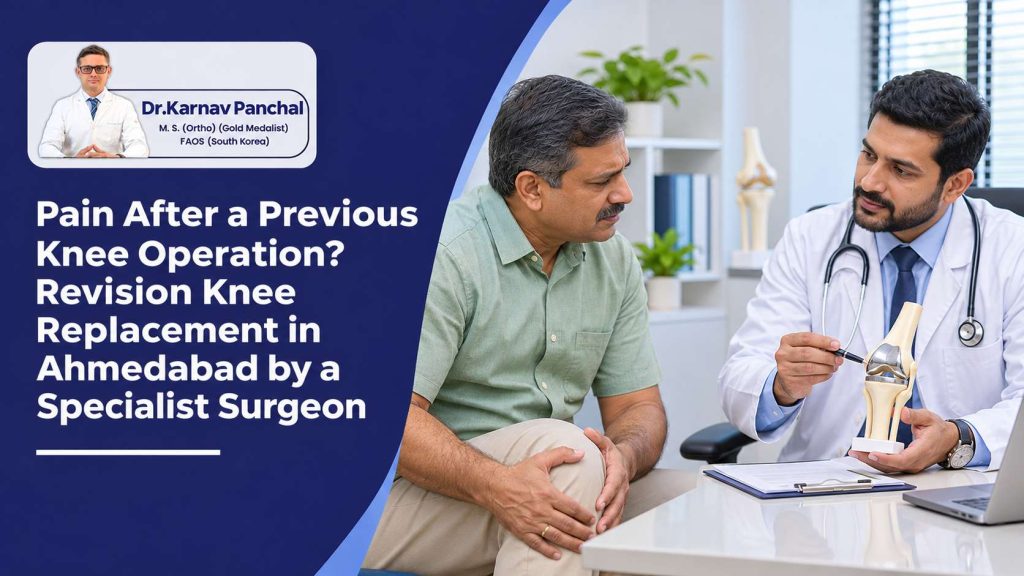
Most knee replacements do well for many years. When one does not, the pain, swelling or wobbliness can feel more discouraging than the original arthritis, because you have already been through surgery once. Revision knee replacement in Ahmedabad is the operation that removes some or all of a failed knee implant and replaces it with new components. Dr. Karnav Panchal performs primary and revision total knee replacement at Empire Hospital in Sola and Epic Multispecialty Hospital in Thaltej.
This article explains why knee replacements fail, how the cause is found, what the operation involves, and what to expect in 2026 if you are facing a second operation on the same knee.
What Is Revision Knee Replacement?
Revision knee replacement, also called revision total knee arthroplasty, is a surgery to correct a knee replacement that has failed or is causing problems. The surgeon removes the original components, deals with any infection, bone loss or ligament damage, and implants new components that are often longer, more stable or specially designed for revision.
It is not simply a repeat of the first operation. Scar tissue, weakened bone and altered ligaments make it technically more demanding, which is why revision TKR surgery is best performed by a surgeon trained specifically in revision arthroplasty. The AAOS OrthoInfo overview of revision total knee replacement explains these differences in patient-friendly terms. If you are being evaluated for revision knee replacement in Ahmedabad, ask whether your surgeon has this specific training.
Why Do Knee Replacements Fail?
Understanding the cause is the first step in planning revision knee replacement in Ahmedabad. Every knee implant faces mechanical stress for years. Failure can happen early, within the first year or two, or late, after many years of good function. The common causes are:
Loosening and wear
Over time, the polyethylene insert can wear, and the bond between implant and bone can weaken. A loose knee implant usually causes pain on standing and walking, sometimes with a feeling that the knee is shifting.
Infection
Infection around an implant, known as periprosthetic joint infection, can appear soon after surgery or years later through bacteria spreading from elsewhere in the body. Signs include persistent pain, warmth, swelling, redness, fever or discharge from the wound.
Instability
If the ligaments are not balanced or have stretched, the knee may feel wobbly or give way, particularly on stairs or uneven ground.
Stiffness
Some knees develop excessive scar tissue and lose movement. When physiotherapy and simpler procedures fail, revision may be needed to restore range of motion.
Fracture around the implant
A fall can break the bone around the components. Depending on the fracture and implant stability, it may need fixation or revision.
Malalignment
If components were positioned in poor alignment, uneven loading can lead to early wear, pain and instability.
Signs You May Need Revision Knee Replacement in Ahmedabad
Not all pain after knee replacement means the implant has failed. Some discomfort and swelling are normal for several months. However, see a specialist if you notice:
- Pain that returns after a period of good function
- Pain that has never settled more than six months after surgery
- New or increasing swelling
- Warmth, redness, fever or wound discharge
- A sense of instability or the knee giving way
- Reduced ability to bend or straighten the knee
- A clicking, grinding or clunking sensation that is new
People often delay because they assume these problems are just “how a replaced knee feels.” Early evaluation can mean a simpler revision, or in some cases no surgery at all.
How Is the Cause of Failure Diagnosed?
Before any revision knee replacement in Ahmedabad, finding the cause is the most important step. A redo knee replacement performed without identifying the real problem can fail again for the same reason.
- History: when the pain started, whether the knee was ever pain-free, and any wound problems after the first surgery.
- Examination: stability, range of motion, alignment and signs of infection.
- X-rays: compared with earlier films to look for loosening, wear, malposition or fracture.
- Blood tests: inflammatory markers such as ESR and CRP help screen for infection.
- Joint aspiration: fluid drawn from the knee is tested for infection when it is suspected.
- Advanced imaging: CT scans or other studies may be used to assess component rotation and bone loss.
Bring the operation notes, implant stickers and old X-rays from your first surgery if you have them. Knowing the original implant helps planning a great deal.
How Is Revision Total Knee Arthroplasty Performed?
The exact plan depends on why the knee has failed.
Revision for loosening, wear or instability
Surgery for a loose knee implant begins with careful removal of the old components to preserve as much bone as possible. Bone defects are filled with bone graft, metal augments, cones or sleeves. Revision implants with longer stems are often used to transfer load to healthier bone, and more constrained designs are chosen when ligaments are deficient.
Revision for infection
Infection is one of the most serious reasons for revision, and it may be treated with a one-stage or two-stage approach.
- One-stage revision: the infected implant is removed, the joint is thoroughly cleaned, and new components are inserted in the same operation. It suits selected cases where the organism is known and the soft tissues are healthy.
- Two-stage revision: the implant is removed and an antibiotic-loaded cement spacer is placed. After a course of antibiotics and confirmation that the infection is controlled, the final revision implant is inserted in a second operation.
Your surgeon will discuss which approach suits your situation based on the organism, your health and the condition of the tissues.
Partial revision
Sometimes only one component, such as the polyethylene insert, needs replacement. Patients often call any second operation a redo knee replacement, but an insert exchange is far smaller than a full revision. This is a smaller operation, but it is suitable only when the rest of the implant is well fixed and correctly positioned.
Recovery After Revision Surgery
Recovery after complex knee replacement revision is usually slower than after a first replacement. Most patients begin walking with support soon after surgery, but full recovery takes longer and depends on bone quality, the extent of reconstruction and whether infection was present.
| Factor | How it affects recovery |
| Simple insert exchange | Often closer to a primary replacement recovery |
| Bone grafting or augments | May require protected weight bearing for a period |
| Two-stage infection revision | Two hospital stays and a longer total treatment time |
| Pre-existing stiffness | Needs intensive, sustained physiotherapy |
Regular follow-up and physiotherapy are essential. The aim of every revision knee replacement in Ahmedabad that Dr. Panchal performs is a stable, pain-free knee that allows comfortable walking and daily activities.
Revision Knee Replacement Cost in Ahmedabad
The revision knee replacement cost in Ahmedabad is usually higher than a first-time replacement. The main factors are:
- The type of revision implant, stems, augments or cones required
- Whether bone graft is needed
- One-stage versus two-stage surgery for infection
- Length of hospital stay and need for intensive care
- Antibiotic treatment and laboratory testing
- Physiotherapy and follow-up
Because each revision knee replacement in Ahmedabad is different, a reliable estimate is only possible after assessment and imaging. Ask for an itemised quote and check what your insurance policy covers for revision surgery. Knee implant prices in India are regulated by the National Pharmaceutical Pricing Authority, which first capped them in August 2017, although some specialised revision components may fall outside standard categories.
Why Choose a Revision Specialist?
Revision knee replacement in Ahmedabad is one area where specific training makes a real difference. Dr. Karnav Panchal’s profile lists:
- M.S. (Orthopaedics), B. J. Medical College and Civil Hospital, Ahmedabad
- Fellowship in primary and revision arthroplasty, Bombay Hospital, Mumbai
- Fellowship in advanced arthroscopy and sports medicine, St. Mary’s Hospital, Daejeon, South Korea
- A stated interest in complex primary and revision joint replacement
- Membership of the Indian Society of Hip and Knee Surgeons
- Director of the Freedom Joint Care Centre at Epic Hospital, Thaltej
As a revision knee replacement surgeon serving Gujarat, he sees patients from Ahmedabad, North Gujarat and neighbouring states, including those whose first surgery was done elsewhere. The case studies section of his website describes some of the complex knee replacement cases managed by the practice.
Second Knee Replacement Surgery on the Same Knee: What to Ask
Before agreeing to a second knee replacement surgery on the same knee, ask your surgeon:
- What exactly has caused the failure, and how was it confirmed?
- Has infection been ruled out?
- Is a full or partial revision needed?
- What implants and bone reconstruction techniques will be used?
- What is the likely recovery time and expected result?
- How often do you perform revision knee surgery?
Clear answers to these questions are the best sign that the revision knee replacement in Ahmedabad you are considering is well planned.
Frequently Asked Questions
How do I know if my knee replacement has failed?
Warning signs include pain returning after a pain-free period, ongoing swelling, warmth, instability, stiffness or new clicking. These need assessment with X-rays and blood tests, as not all pain means implant failure.
Is revision knee replacement more difficult than the first surgery?
Yes. Scar tissue, bone loss and weakened ligaments make revision more complex. It usually takes longer, may need special implants and bone grafts, and is best done by a surgeon trained in revision arthroplasty.
Can an infected knee replacement be treated without removing the implant?
In very early infection, a washout with exchange of the plastic insert and antibiotics may be enough. Long-standing infections usually need one-stage or two-stage revision to clear the infection reliably.
How long does recovery from revision knee surgery take?
Recovery after revision TKR surgery is generally slower than after a first replacement. Most patients walk with support soon after surgery, but full recovery may take several months, particularly after bone grafting or two-stage infection treatment.
Does Dr. Karnav Panchal treat patients whose first surgery was done elsewhere?
Yes. Dr. Karnav Panchal assesses patients whose original knee replacement was performed at another hospital. Bring your operation notes, implant details and old X-rays to help with planning.
Is revision knee replacement covered by insurance?
Insurance can cover much of the revision knee replacement cost when surgery is medically necessary. Coverage depends on the policy terms, waiting periods and sub-limits, so request a pre-authorisation estimate from the hospital.
How long does a revision knee replacement last?
Revision implants can function well for many years, but results depend on bone quality, the cause of failure and whether infection was present. Careful planning and specialist surgery give the best chance of a durable result.
Get Your Painful Knee Replacement Assessed
If your replaced knee is painful, swollen or unstable, a careful evaluation by a surgeon experienced in revision knee replacement in Ahmedabad can identify the cause and the right solution. Call +91 92657 01776 or book a consultation with Dr. Karnav Panchal at Sola or Thaltej.